Reading Time: 5 min.
With Royal Oak Joaillerie, the Swiss watchmaker transforms its most recognizable design into high jewelry, proving that an icon can transcend its original purpose without losing its identity.
What makes an object iconic? Its history, its function, its beauty—or its ability to remain instantly recognizable even when it no longer serves the purpose for which it was created?
In the world of fine watchmaking, few designs answer that question as convincingly as Audemars Piguet’s Royal Oak.
More than five decades after its debut, its distinctive geometry has become so deeply embedded in the language of luxury that it no longer needs a dial or hands to make a statement.
With Royal Oak Joaillerie, Audemars Piguet transforms the architectural codes of its most celebrated timepiece into high jewelry, reimagining its integrated bracelet, sculptural links, and geometric details through precious metals and gemstones.
The result is not simply a watch transformed into an accessory. It is an exploration of what happens when design becomes more powerful than function.
Royal Oak: The Watch That Redefined Luxury
To understand the significance of this collection, we need to return to 1972.
That year, legendary designer Gérald Genta created a watch for Audemars Piguet that challenged the conventions of luxury watchmaking: the Royal Oak.
At a time when precious metals largely defined the traditional image of fine watches, Genta introduced a luxury sports watch crafted in stainless steel, elevating the material through exceptional finishing and a radically different design.
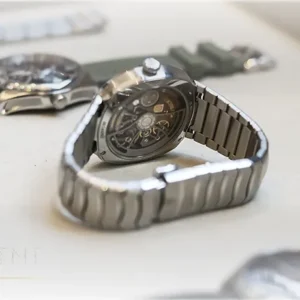
Its octagonal bezel, visible screws, and integrated bracelet established an identity that would become unmistakable.
But there was something else.
The bracelet was never merely a functional component designed to hold the watch in place. Its architecture, alternating polished and satin-brushed surfaces, and meticulously articulated links were essential to the overall composition.
In a sense, the Royal Oak had always possessed the qualities of jewelry.
In 1976, Jacqueline Dimier reinterpreted the design for women, opening new possibilities for its proportions and aesthetic expression. During the following decades, Audemars Piguet continued exploring the relationship between watchmaking and jewelry, establishing its own jewelry workshop in the 1980s and developing increasingly elaborate creations.
Royal Oak Joaillerie represents another chapter in that evolution.
Royal Oak Joaillerie: When Architecture Becomes Jewelry
The new collection preserves the Royal Oak’s unmistakable design language while freeing its forms from the need to accompany a mechanical movement.
Bracelet links become sculptural structures. Octagonal elements take on new proportions. Precious metals interact with gemstones and finishes that capture light in unexpected ways.
The collection includes necklaces, chokers, cuffs, and earrings that maintain a recognizable connection to the original timepiece without simply reproducing it.
There is a particularly compelling idea behind this transformation: when a design is truly iconic, it can change its scale, material, and even purpose without losing its identity.
Royal Oak Joaillerie unfolds through three distinct expressions: Dream of Joux, Risoud Eclipse, and Frosted Gold.
Each draws inspiration from the landscapes, colors, and shifting light of Switzerland’s Vallée de Joux, where Audemars Piguet was founded in 1875.
Dream of Joux: The Swiss Landscape Reimagined in Gemstones
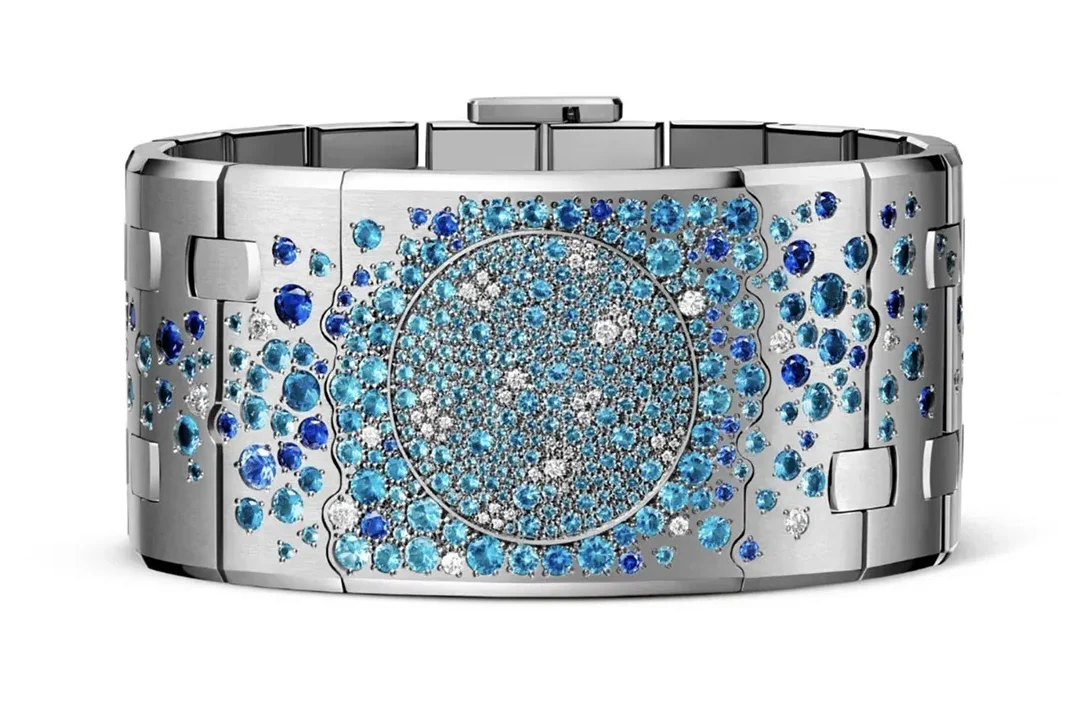
The first expression of Royal Oak Joaillerie takes inspiration from frozen lakes, star-filled skies, alpine flowers, and the natural beauty of the Vallée de Joux.
Dream of Joux combines 18-karat white, yellow, and pink gold with diamonds and colored gemstones, including sapphires, spessartite garnets, tourmalines, amethysts, tsavorites, and topazes.
The compositions translate the colors and textures of the landscape into wearable works of high jewelry.
Among the collection’s highlights are the Frozen Lake, Tree of Life, and Edelweiss designs, whose contrasting tones evoke everything from icy surfaces to the richness of alpine vegetation.
The collection also features a tie necklace and matching drop earrings combining pear-shaped diamonds with blue sapphires in snow-set arrangements.
Rather than reproducing nature literally, these creations reinterpret its rhythms, contrasts, and colors through the architectural language of the Royal Oak.
Risoud Eclipse: The Drama of Emeralds and Black Titanium
If Dream of Joux celebrates color and luminosity, Risoud Eclipse explores a darker, more enigmatic aesthetic.
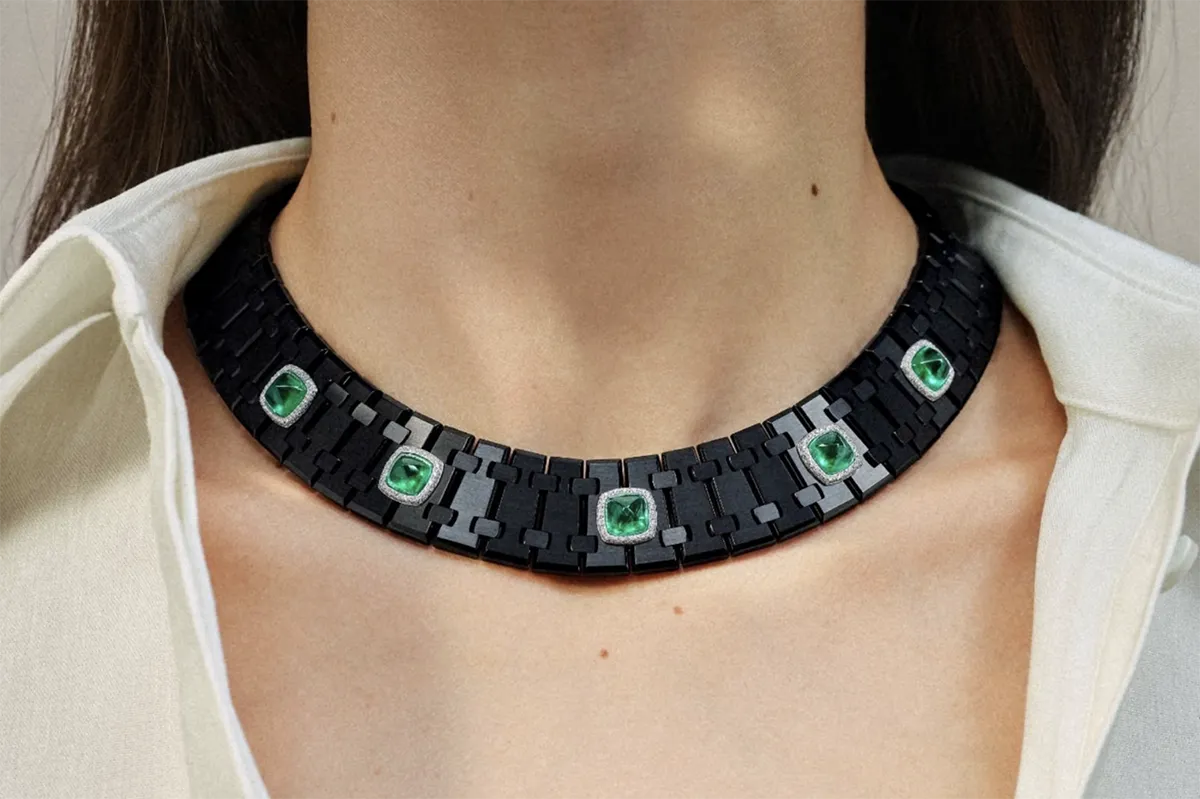
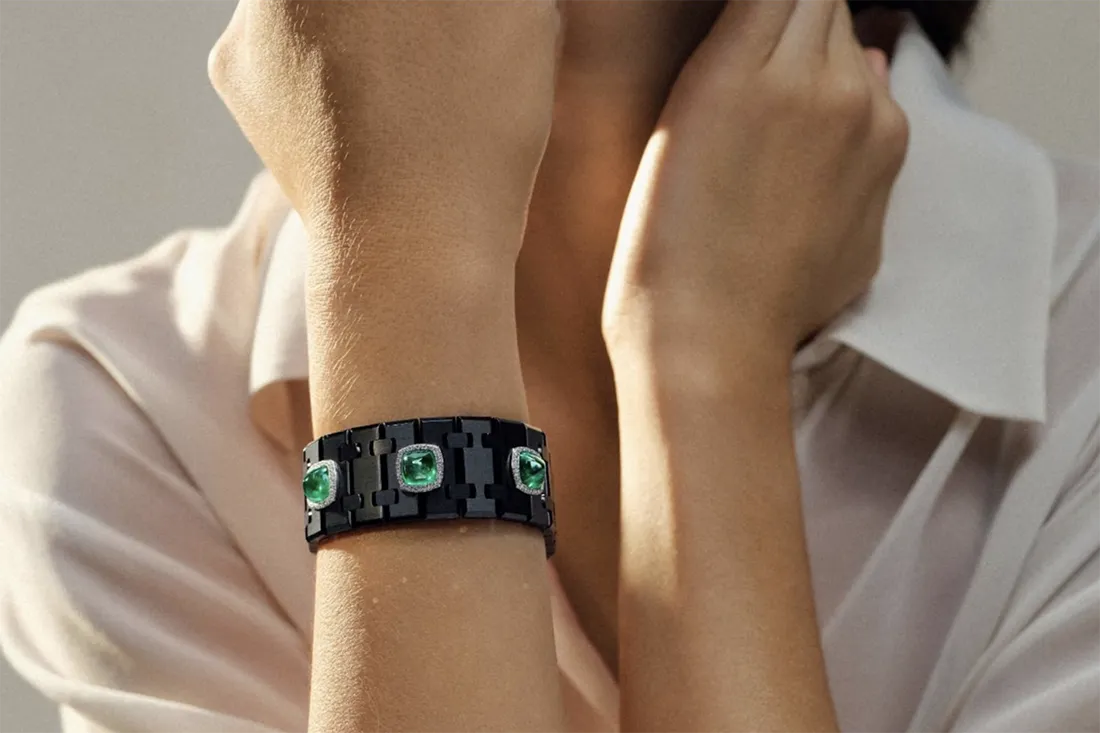
Inspired by the Risoud Forest beneath an eclipse, this expression combines blackened titanium, 18-karat white gold, diamonds, and emeralds.
The focal points are prominent sugarloaf-cut emeralds, distinguished by their smooth, domed surfaces and softly rounded silhouettes.
Their organic forms create a striking contrast with the structured geometry of the Royal Oak-inspired links.
The deep black finish of the titanium intensifies the emeralds’ vivid green, while brilliant-cut diamonds introduce flashes of light.
Across the necklace and cuff, the composition creates a visual tension between darkness and brilliance, nature and technical precision.
It is perhaps the collection’s most dramatic expression: high jewelry that does not rely on sparkle alone to command attention.
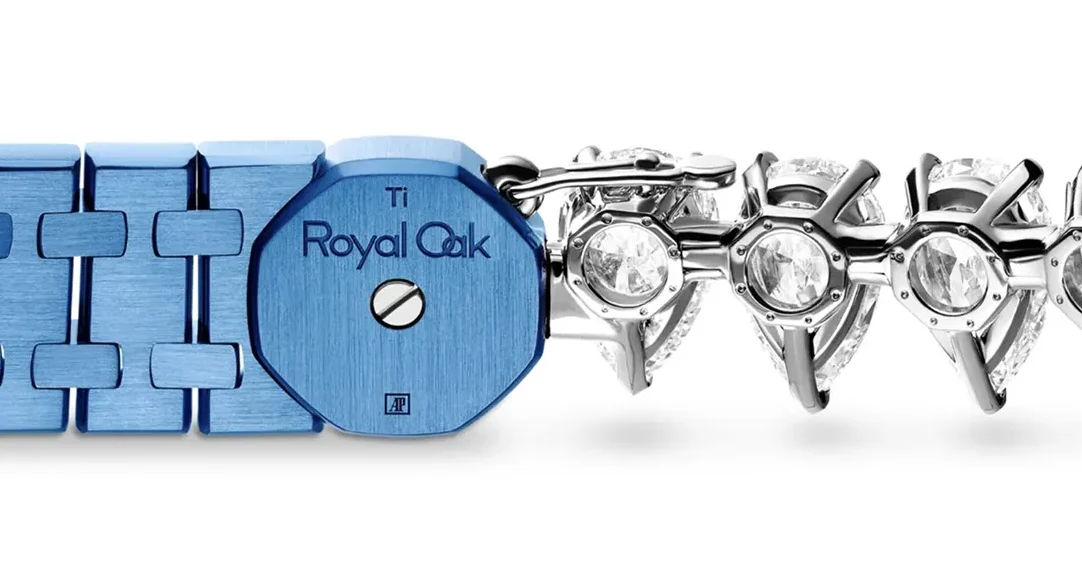
Frosted Gold: Making Gold Shimmer Like Diamond Dust
The third expression revisits a technique that has become part of Audemars Piguet’s contemporary design history.
In 2016, the Swiss manufacturer collaborated with Italian jewelry designer Carolina Bucci to introduce Frosted Gold to the Royal Oak, drawing inspiration from a traditional Florentine goldsmithing technique.
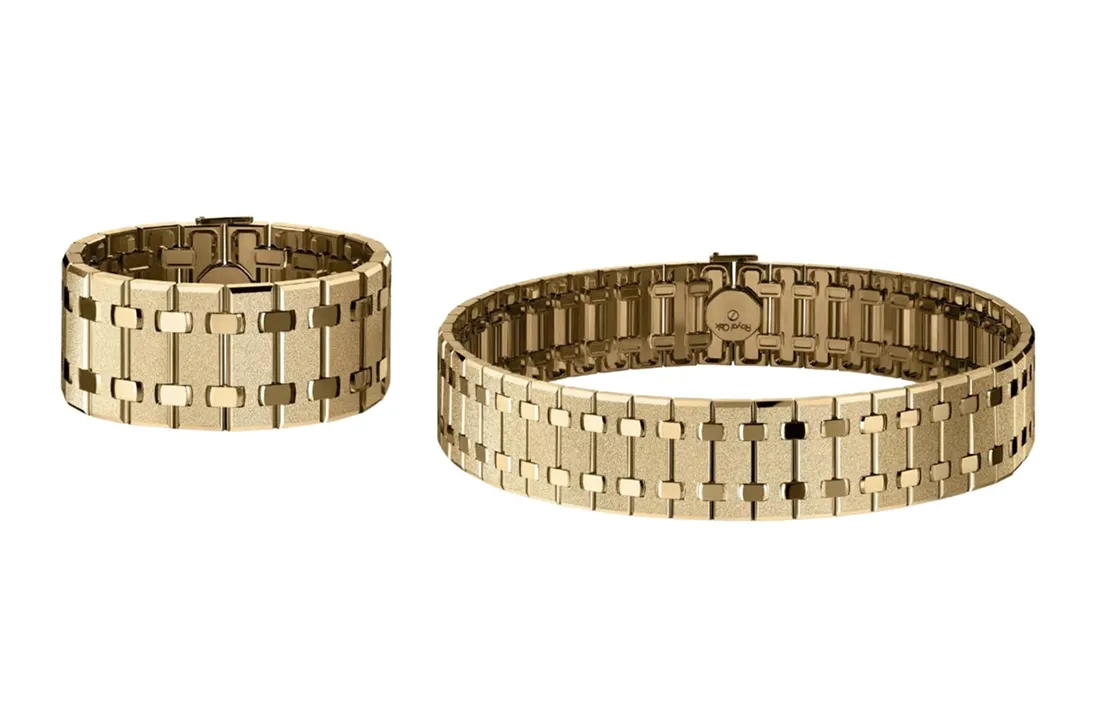
Through meticulous surface treatment, gold acquires a finely textured finish that reflects light from countless tiny points, creating an effect reminiscent of diamond dust.
In Royal Oak Joaillerie, this technique appears on chokers and cuffs crafted in 18-karat white, pink, and yellow gold.
The pieces reinterpret the distinctive geometry of the Royal Oak through the expressive qualities of the metal itself.
Unlike conventional gemstone-focused high jewelry, Frosted Gold demonstrates how texture and craftsmanship can become the primary sources of visual impact.
Here, gold does not simply provide the structure of a jewel.
It becomes the jewel’s defining feature.
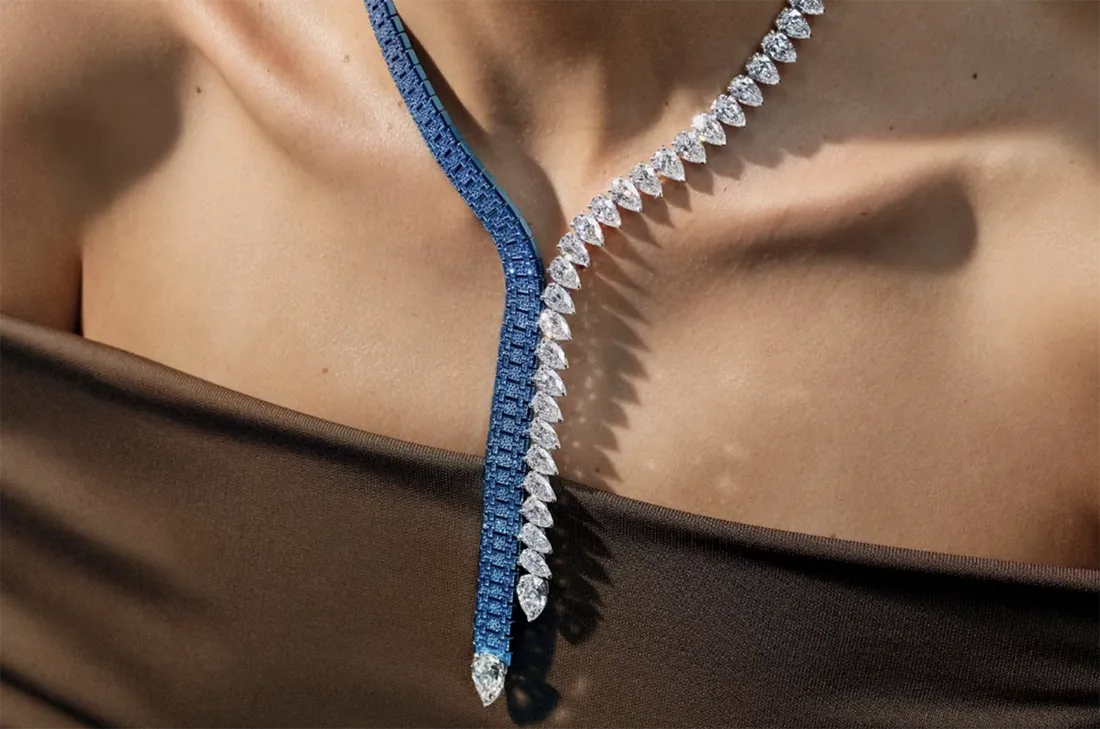
Why Is Audemars Piguet Bringing the Royal Oak Into High Jewelry?
The introduction of Royal Oak Joaillerie also reflects a broader evolution in the luxury industry.
The boundaries between fine watchmaking, high jewelry, fashion, and design have become increasingly fluid. Established houses are exploring new ways to express their identities beyond the products that originally made them famous.
For Audemars Piguet, the transition feels particularly natural.
The brand does not need to invent a new aesthetic language. It already possesses one of the most recognizable designs in contemporary watchmaking, supported by a long history of craftsmanship and experimentation with precious materials.
Royal Oak Joaillerie allows that heritage to be explored from another perspective, appealing to collectors who appreciate both horological precision and the artistic possibilities of high jewelry.
It also raises an interesting question about the future of luxury: can the identity of a legendary product become valuable enough to exist independently of the product itself?
In the case of the Royal Oak, the answer appears to be yes.
Availability and purchasing information for the collection can be requested through Audemars Piguet’s official channels and selected boutiques.
The Ultimate Luxury Is Having an Identity of Your Own
The story of the Royal Oak demonstrates that some objects eventually become far more significant than their original function.
What began as a revolutionary stainless-steel sports watch in 1972 evolved into a design reference capable of reinventing itself for more than half a century without losing its personality.
Now, its forms find a new expression in high jewelry.
And perhaps that is where the real sophistication of Royal Oak Joaillerie lies.
It does not attempt to turn a watch into something entirely different. Instead, it reveals a quality that was present in the design from the beginning.
Because when a creation achieves the status of an icon, it no longer needs to tell us the time to remind us of its value.
Follow us on Statement.
images
Royal Oak Joaillerie, Audemars Piguet.