
Reading Time: 2 min.
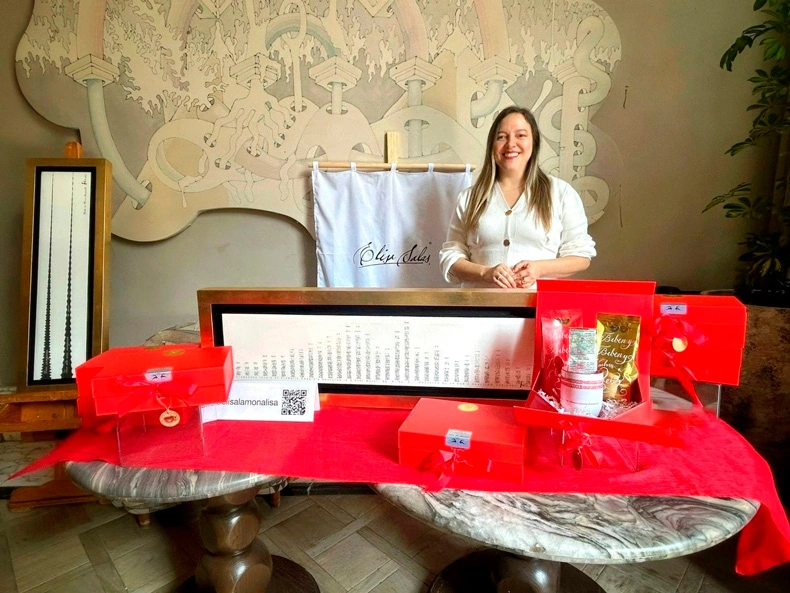
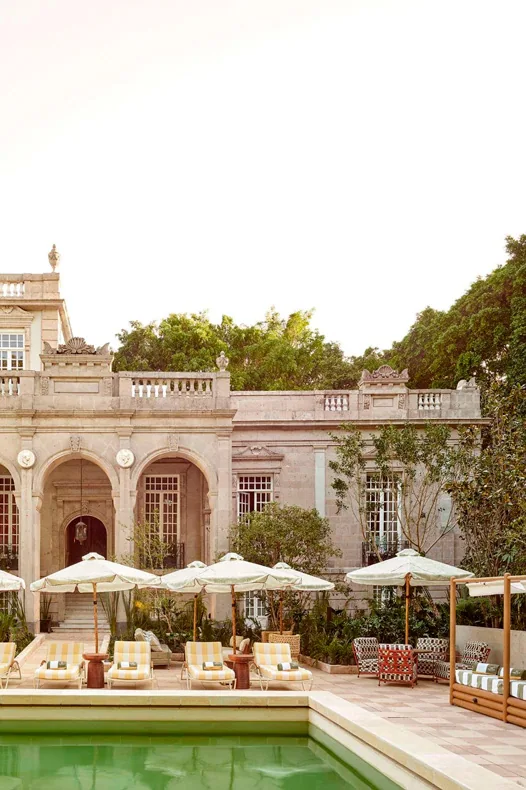
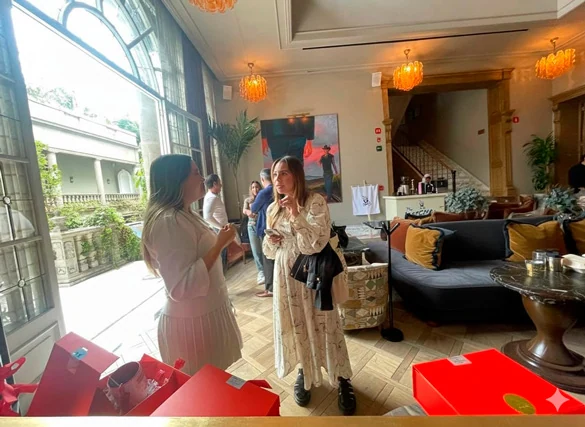
Closing the year on a sensitive and deeply contemporary note, Elisa Salas presented a pop-up at Soho House as part of its Winter Market, a gathering curated by the British-born private members’ club known for connecting the creative industry under an unspoken rule: no ties, no rigidity, just genuine exchange.
It was the ideal setting for a body of work that is not meant to be seen alone, but heard, felt, and interpreted.
Landscapes where sound becomes form
What Elisa Salas presented at Soho House reflects one of her most abstract and consistent practices: that of a sound landscape artist. Her work centers on the creation of sonograms, visual translations of sound waves born from laughter, bells, ultrasounds, whale songs, birdsong, water drops, onomatopoeias, and subtle vibrations.
Her intention is not to illustrate sound, but to visually analyze meaning through vibration. The work is rooted in a premise that is both scientific and poetic: everything that exists vibrates, and within that vibration lies information.
This approach led, in 2018, to a collaboration with the National Polytechnic Institute of Mexico (IPN) alongside an astrophysicist, where she developed soundscapes based on the sounds of galaxies—positioning science and art not as opposites, but as complementary languages.
Caligrams for the 21st century
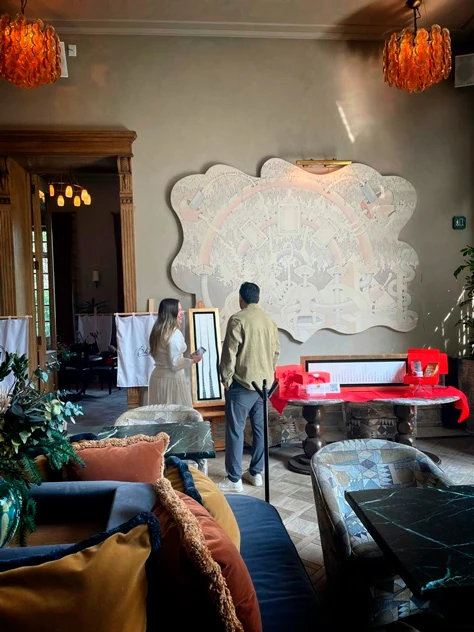
Elisa Salas has specialized in developing contemporary caligrams, grounded in a powerful belief: every word is also vibration. At this stage of her career, her work continues to explore the boundary between sound, language, and form, while paying tribute to concrete poetry.
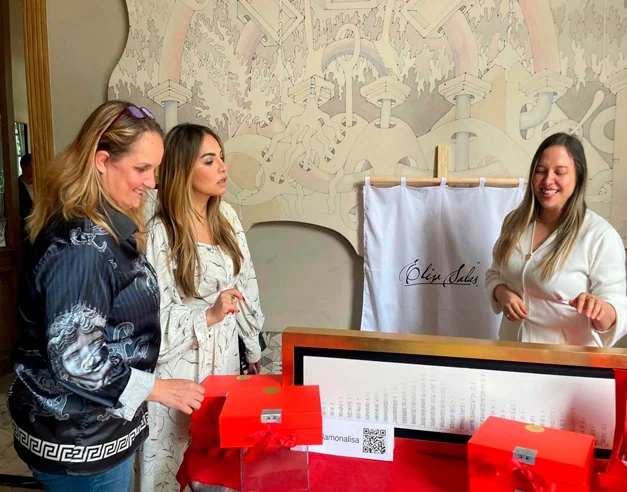
Books, chapters, poems, and Christmas carols are deconstructed and reinterpreted over sound landscapes, releasing words from their original structure and allowing them to inhabit space freely. A gesture that echoes the dream of the 20th-century French poètes maudits: to liberate words from the page.
A trajectory that crosses disciplines and geographies
Throughout her career, Elisa Salas has collaborated with brands such as Montblanc, Breitling, Audi, Montegrappa, Faber-Castell, S.T. Dupont, and Mexicráneos, and has exhibited her work internationally, from the Museum of Broken Relationships in Los Angeles to the New York Poetry Festival, as well as in Japan, Italy, Greece, Portugal, Miami, and Washington, D.C.
She has completed four international artist residencies and holds extensive training in sculpture, drawing, painting, art, and literature across Italy, the United States, and Mexico. In her home country, her work has been shown in museums, art fairs, and public spaces, including exhibitions at the Soumaya Museum, MUNAL, Franz Mayer Museum, and the monumental skull intervention created in collaboration with Mexicráneos, displayed on Paseo de la Reforma and in Mexico City’s historic center.
Her bronze sculpture From Cage to Bird, unveiled in Lincoln Park in Polanco, is currently absent—removed from its pedestal—and has become, unintentionally, a symbol in itself.
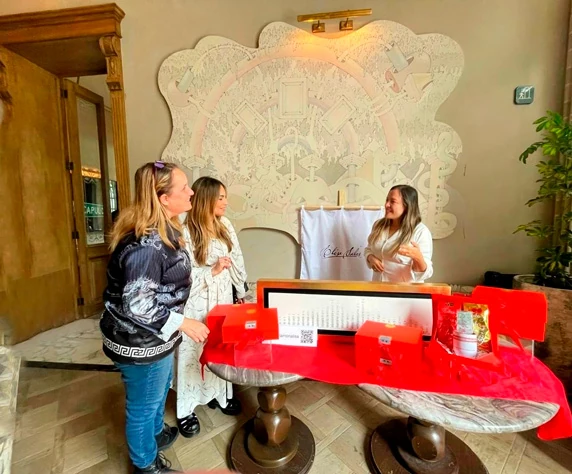
Listening as a creative act
From publishing her first novel over 25 years ago to her 11-year exploration of postmodern caligrams, Elisa Salas has developed a practice that bridges literature, science, and visual art. In 2017, she was cited by the press as the most significant developer of caligrams in Mexico, and since 2019 her work has been part of the Milenio Collection, curated by Avelina Lésper.
Her presence at Soho House was not a conventional year-end showcase. It was a pause.
A reminder that before looking, one must listen.
Because in a world saturated with noise, the most radical gesture is paying attention to vibration.
Follow our networks on Statement.
images
Elisa Salas.
Share